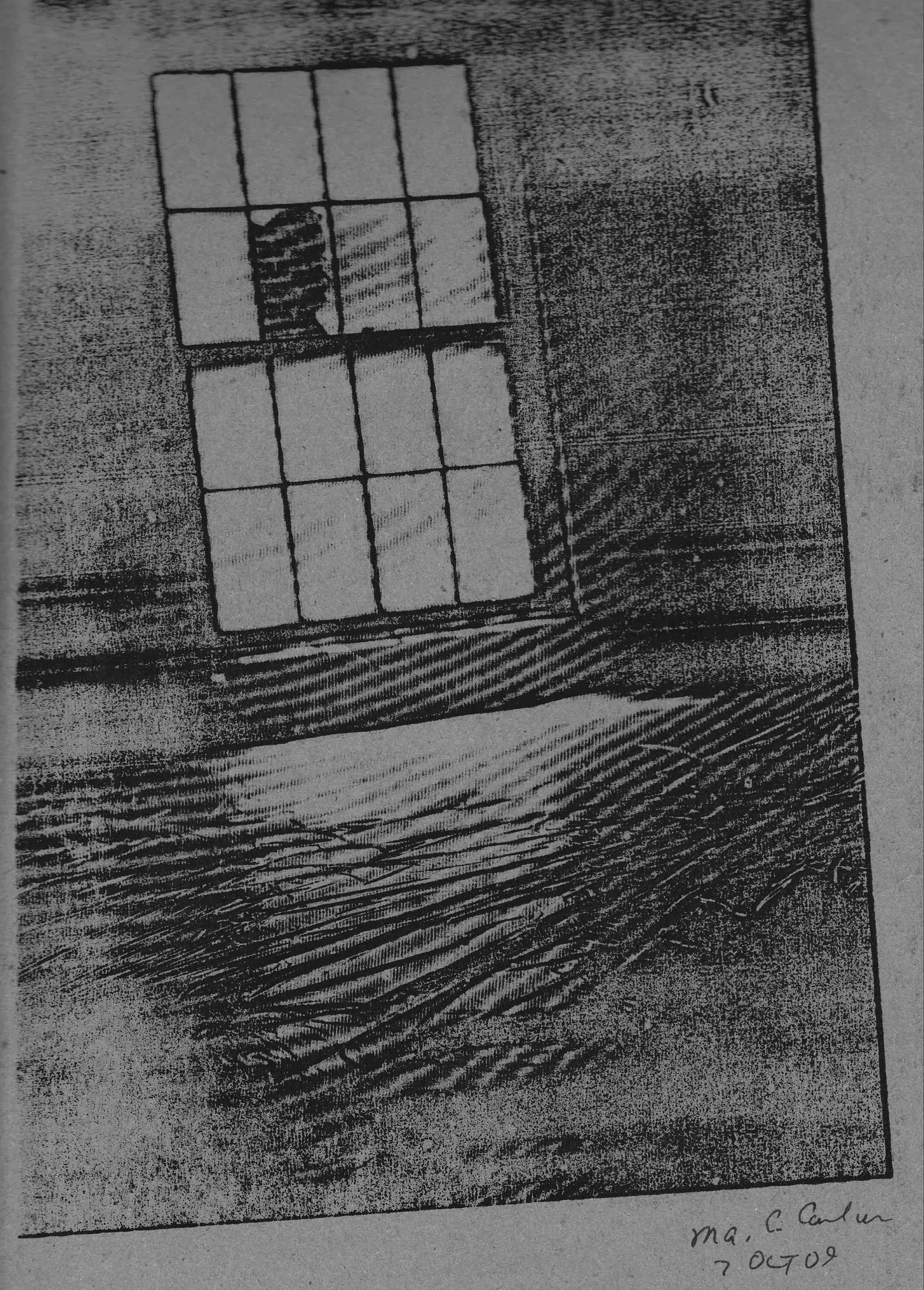
Transitions – 1st painting posted


Jephthah’s daughter (Judges 11: 21-40) is Gilead’s granddaughter.  Jephthah was Gilead’s bastard son.  To understand Gilead, one must think of a superhero.  His son, once rejected as a bastard, became regarded as a superhero as well, because he helped deliver his people from their enemies.  But he blamed his daughter when she greeted him after this victory with timbrels and dancing, because he promised to sacrifice the first he sees when he comes home from battle when assured victory.

Jephthah’s daughter was sacrificed.  In this painting, I imagined her in those two months that she wandered in the mountains bewailing her virginity, after which she returned to her father, “who did with her according to the vow he had made.” [Judges 11:39].  So for four days every year the daughters of Israel would go out to lament the daughter of Jephthah, the Gileadite. [11:40].

Dr. Lion Feuchtwanger, who left Germany when Hitler came into power, wrote a novel based on the 47 verses in the book of Judges, Jephta and his Daughter.  He wrote in his notes that the events recorded in the book took place between 1,300 and 1,000 years before the beginning of our epoch. Those who chronicled them, however, lived in the ninth or eight centuries B.C., and the final version was probably written not before the sixth century B.C.  Yet the book contains some of the most powerful stories that can match any superhero fantasy of our time: the war song of Deborah, the folk tales of Gideon, “the Hammerer,” the daredevil, the stories of Samson and the story of Jephta.

Jephtha’s daughter was sacrificed.

Posted in Uncategorized | Leave a comment

Tomorrow is St.Patrick’s Day


In honour of St. Patrick’s Day, I am sharing a reflection I gave at World Food Day in 2004.

World Food Day celebrates the October 1945 founding in Quebec City  of the Food and Agricultural Organization, also known as the FAO. The FAO was founded with the resolve of 44 countries to defeat all hunger and famine. It was at this occasion that the British government first acknowledged that a famine had taken place in Ireland 100 years before.

For those who study the Irish famine, the place of the founding of the FAO is remarkable. Quebec City is just 33 kilometers from Grosse Ile, an island  in the St. Lawrence which was the Canadian disembarkation point for Irish emigrants fleeing the Great Famine, as well as a cemetery for the thousands who were destined to go no further. As we reflect on this history, will we see repeated the same responses and practices  in the way we respond to hunger now?

Since the end of the Eighteenth Century the rural population of Ireland had come to depend on the potato as its staple food because this crop produced more food per acre than wheat and could also be sold as a source of income, although the tuber was not indigenous to Ireland.  In 1845, a fungus that thrived in the wet climate destroyed that year’s potato harvest. The blight continued for two more years, with one million people dying with starvation or ensuing disease.

During the winter of 1845-46, Peel’s government spent £100,000 on American maize which, so as people would not get something for nothing, was sold to the destitute. In 1846, even if the Corn Laws were repealed, it had no effect on hungry people because however cheap the grain was, without money, the Irish peasants could not buy it.

In 1847, no government at Westminster was prepared to give food to the starving, on the grounds that the Irish already were lazy and free food would merely encourage this trait. In contrast, Calcutta, India sent 16,500 pounds of aid, Bombay another 3,000. Florence, Antigua, France, Jamaica and Barbados sent contributions. The Choctaw tribe in North America sent $710. The Quakers, and many synagogues in Britain and America also contributed generously to the Relief Committees for Ireland.

In an effort to ensure that people did not get “something for nothing,” an earlier version of workfare was initiated:  relief schemes such as canal-building and road building to provide employment so as to ensure that only the “deserving” received assistance. The workers were paid at the end of the week and often men died of starvation before their wages arrived. Even worse, many of the schemes were of little use: men filled in valleys and flattened hills just so the government could justify the cash payments.

The major problem was not that there was no food in Ireland – there was plenty of wheat, meat and dairy produce, much of which was being exported to England – but that the Irish peasants had no money with which to buy the food. It was a time when Irish peasants starved in the midst of plenty. Wheat, oats, barley, butter, eggs, beef and pork were exported from Ireland in large quantities during the Famine. In fact, eight ships left Ireland daily carrying many foodstuffs.

Poor tenants amassed huge tax debts they could no longer afford. The imposition of England’s Poor Law made each landlord responsible for subsidizing tenants who paid less than four pounds in yearly rent. One solution was “assisted emigration.” Landlords evicted the poor from the land, and, to be sure to get rid of them, paid for their passage on one of the emigrant ships bound for Canada, Australia or America.

Conditions on the ships that brought the Irish to Canada were appalling. Starvation and cholera combined to make these ships truly “coffin ships.” To cope with this and the want of proper sanitation, Toronto passed sanitary regulation in June 1847, which mandated Quarantine sheds. The first sheds in the city were for cholera and placed at the north-west corner of King and John. Other sheds set up near Bathurst were for typhus. As the health problems and numbers of immigrants kept growing, more sheds were built. Toronto’s first Roman Catholic bishop, Michael Power, died on 1 Oct., 1847, of typhus contracted while attending the immigrants at the fever-sheds.

So famine is not just a far away story: The land bounded by Metro Hall and Parliament Street,  and from here to the lake saw famine, just over 150 years ago.

Memorials can be found at the north entrance to Metro Hall  and at St. Paul’s Church on Queen Street East in remembrance of this part of Toronto’s history.

We recall this history, in the very neighbourhood where so many of the Irish victims of famine ended their days, and bring to mind a similar disaster, the one that occurred in Ethiopia in the 1980s and continues to the current day. But even as we remember, we celebrate this feast today, because there is abundant food, and this abundant food must be shared.

Tina Conlon

St. Lawrence Hall

19 October 2004

Posted in Uncategorized | Leave a comment

“Saphira and Other Stories Brought to Light” show closed early!


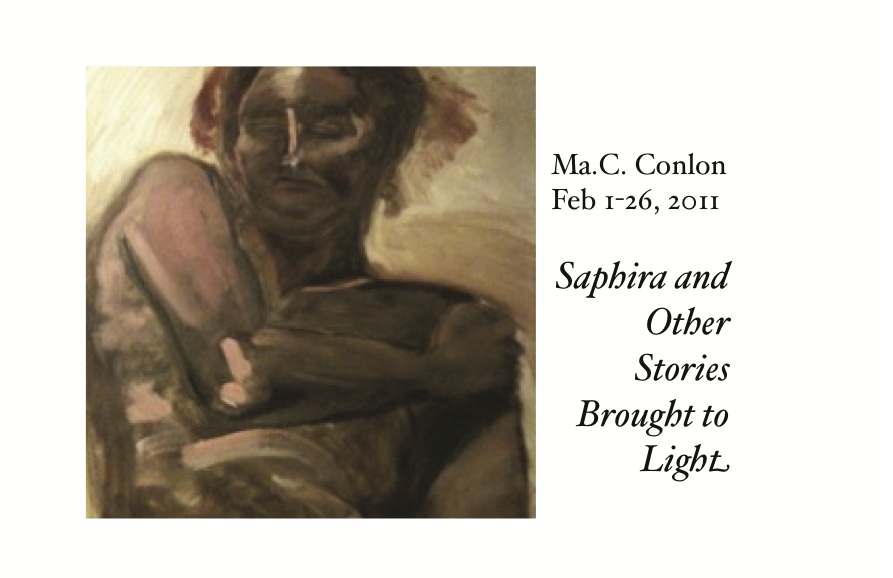
Saphira and Other Stories Brought to Light

my first solo show

ARTbeat Poster 7-reduced The last Old Town ARTbeat event was an art exhibit, “Saphira and Other Stories Brought to Light,” featuring some of my artwork (and Old Town ARTbeat posters!) which was to have been on display at Chaska until Saturday, February 26. Unfortunately, Chaska is closing and I had to take down all the pictures on Monday, February 21.

I was honoured to have so many friends and art appreciators at the reception. After explaining how some of the artwork is trying to offer a material trace of Biblical narratives, many requested more information about these stories and what they mean. The story of Saphira was intriguing; that of Jephthah’s daughter was chilling.

A few people suggested that we hold some study sessions to learn more about these stories, incorporating meditation (yoga?) and prayer. I’ve never really done yoga before (someone else offered!) but am very interested in getting into dissecting these stories, in the way of “unprotected texts”.

Mary Druce, one of our featured artists who is an actress, storyteller, and writer said that she had, at one point, thought to follow up her Shakespeare’s Womyn work with stories from the Bible.

Do let me know if you are interested in any of the study sessions.

← Back

Thank you for your response. ✨

Posted in Uncategorized | Leave a comment

A Lesson on Solidarity


A Lesson on Solidarity

A young woman found herself in an embarrassing situation.  She was pregnant but not by the man she was engaged to.  In her tradition, she was presumed to have committed adultery, and she, along with the adulterer were to be put to death.[1]

If her betrothed were to take her for his wife and charges her with shameful conduct and evidences of virginity are not found for the young woman, “then they shall bring out the young woman to the door of her father’s house, and the men of her city shall stone her to death with stones.”[2]

The carpenter Joseph had three options:

  1. Repudiate Mary, expose her embarrassment and make her subject to stoning.
  2. Cop out, as he planned to do,[3] divorce her quietly and let her deal with her own problem. She is not accused by her own husband, the just man, but she will now have to fend for herself.
  3. Take Mary as his wife, name her child, and in that act of naming the child, becomes the father of that child, owning the child.[4] Of Mary, he speaks clearly, “She is mine.  You cannot harm her.”

This act of Joseph, the just man, alludes to another story that is known as the “Pericope Adulterae,” of the famous passage in the Gospel of John about Jesus and the woman taken in adultery[5]. Although scholarship discussion exists about the inclusion, and authorship of this passage, in the gospel of John,[6] what is clear is that this is a story of an act that instead of doing harm to the woman, Jesus shames the accusers, disperses the crowd and averts the execution.

In some cultures, Joseph is regarded as a “cornutto,” or a “cuckold.” By naming the child, he owns that child, that he is the father.  In Matthew’s story, it is Joseph, not Jesus, who averts the execution. In essence, this is what it means to have solidarity, where another takes on another’s shame, or ridicule.


[1] Leviticus 20:10

[2] Deuteronomy 22:3-14, 20-21

[3] Matthew 1:19

[4] Matthew 1:20,24

[5] John 7:53-8:11

[6] Both Novum Testamentum Graece (NA27) and the United Bible Societies (UBS4) provide critical text for the pericope, but mark this off with [[double brackets]], indicating that the pericope is regarded as a later addition to the text. Describing its use of double brackets UBS4 states that they “enclose passages that are regarded as later additions to the text, but are of evident antiquity and importance.”

Posted in Uncategorized | Leave a comment

What we need and what we don’t need


First, watch http://www.youtube.com/watch?v=a6c3j6x7hgA.

In this video, you will see my sister-in-law, a brilliant ceramic artist, methodically putting on safety goggles, then protective gloves, and with a hammer, turning tea pots, vases — beautiful items — into shards and broken pieces.  As we watched her strike each piece, we all cried, “No, that’s too beautiful.”  Each piece was gathered on sheets of paper that was protecting the floor then transferred to a box for recycling into new clay.

My brother and sister-in-law are leaving Toronto.  They offered a closing out sale of her beautiful, ceramic creations.  The items she destroyed were pieces she had left over from that sale.  As an artist, she created and offered things that were expressions of her ideas, visions and dreams for others to enjoy.  But in the end, they were just things. And things, when we do not need them, can drag us down. “Tchothkes”.

In Job 1:21, Job said, “Naked I came from my mother’s womb, and naked shall I return there; the LORD gave, and the LORD has taken away; blessed be the name of the LORD.”

My sister-in-law is a Buddhist and would have smiled at my recollection of this verse. While I cannot claim to understand the Buddhist concept of self-renunciation, her act reminded me of Jesus’ admonition to “sell all you have and follow me/give to the poor,” (Matthew 19:21; Luke 18:22).

For pilgrim people, is this not what we were told when gathering bread from heaven, that we gather as much of it as we need and not leave any of it over until morning (Exodus 16)?

The irony of the current food system is that we turned the food that we need into a commodity that can be hoarded in warehouses, waiting for a better return for investors, while leaving many hungry.  The consequence of this hoarding is the same as the Gulf of Mexico Oil Spill, which we are now at day 52, that began with the April 20 explosion and fire on the drilling rig Deepwater Horizon, owned by Transocean Ltd. and leased by BP PLC, which is in charge of cleanup and containment.

Oil is not just what fuels the vehicles that transport us but in everything else that we use: carpeting, furniture, clothing, even toothpaste, shaving cream, lipstick, vitamin capsules. For want of more of these things, we build bigger drilling rigs that can horde more oil, never thinking of how much it can spill. The Associated Press reported estimates of this oil spill as having more oil flowing in an hour than officials once said spilled in a day.

Do we really need all these things? Do we really need a bigger oil rig? Do we need another oil spill?

God supplied us with what we need. Gather as much of it as each of you needs, all providing for those in their tents.

Salaam, TinaC.

Tina Conlon, 11 June 2010

Posted in Uncategorized | 1 Comment