Fragile Vessels


Fragile Vessels

2012, Handbuilt, Cone 10, Sandstone, Bisque-fired

My assignment was to reflect on the letter “Q”.  The letter “Q,” for the German Quelle, or “source,” contain stories, or fragments held in common by writers Matthew and Luke but in vessels that left no material trace, perhaps due to their fragility and destruction.

In many ways, all materials have always been here.  Clay remains and is recycled. The same material we hold today were here before we were.

Perhaps, the images and the sounds made then have been recorded in these same materials, if we just listen and look very closely.

Posted in Uncategorized | Leave a comment

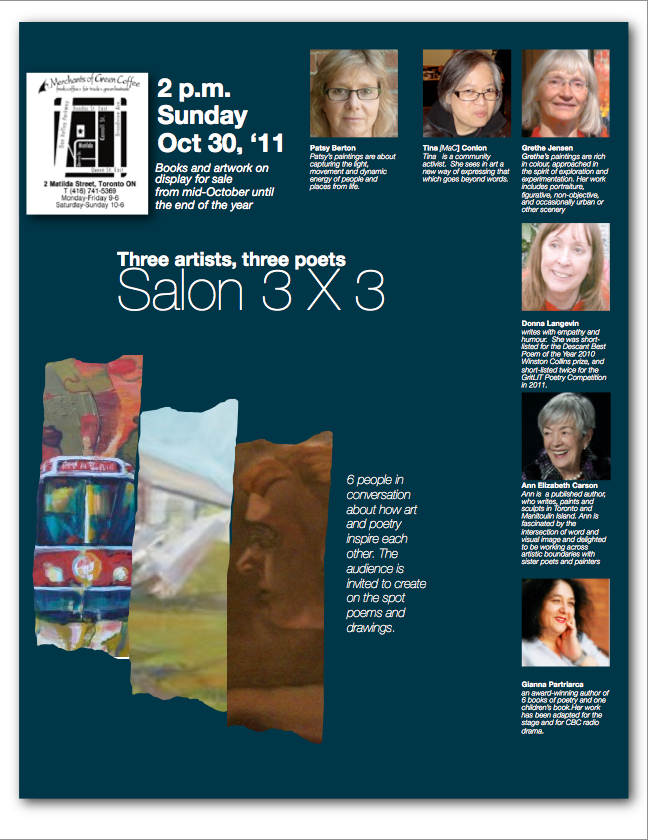
October 30 Salon 3X3 Poster


SALON 3 X 3

6 people; 3 artists 3 poets, in conversation about how art and poetry inspire each other.

In casual conversation, the artists and poets will respond to each other’s work, read poems inspired by art, and vice verse. They will talk about the cross-pollination that happens when artists/writers of different media pay attention to each others work. This is not just “show and read”. They plan to engage the audience in cross-talk, and invite them to create post card poems and crayon drawings – if they want to, nothing mandatory of course.

Participating poets are Ann Elizabeth Carson, Gianna Patriarca, and Donna Langevin, and the artists are Tina Conlon, Patsy Berton, and Grethe Jensen.

Salon 3 X 3 will take place at the Merchants of Green Coffee, 2 Matilda Street (near Queen and Broadview), Sunday October 30, at 2:00 pm. Books and artwork will be on display and available for sale from mid-October until the end of the year.

Posted in Uncategorized | Leave a comment

October 30: Salon 3X3


SALON 3 X 3

6 people; 3 artists 3 poets, in conversation about how art and poetry inspire each other.

In casual conversation, the artists and poets will respond to each other’s work, read poems inspired by art, and vice verse. They will talk about the cross-pollination that happens when artists/writers of different media pay attention to each others work. This is not just “show and read”. They plan to engage the audience in cross-talk, and invite them to create post card poems and crayon drawings – if they want to, nothing mandatory of course.

Participating poets are Ann Elizabeth Carson, Gianna Patriarca, and Donna Langevin, and the artists are Tina Conlon, Patsy Berton, and Grethe Jensen.

Salon 3 X 3 will take place at the Merchants of Green Coffee, 2 Matilda Street (near Queen and Broadview), Sunday October 30, at 2:00 pm. Books and artwork will be on display and available for sale from mid-October until the end of the year.

Let me know if you’d like to get a postcard!

Posted in Uncategorized | Tagged , , , , , | Leave a comment

An Artist Statement


Where theology concerns itself in how the unseen makes its mark on the material, art concerns itself with making a material trace of the unseen. As a student of theology trained for ministry in a mainline, Canadian Protestant denomination, I struggled with systematic theology, which I found severely limited, in giving an account of faith, when placed in the crucible, or in the hermeneutic, of context and history. It was helpful to view the writers who dared to record in “The Book,” as artists who invited and engaged others to see and hear the illusive, irascible character of the unseen.

In many ways, I’ve seen art as an interpretation, or a translation, of things unseen. And it is that interpretation that gives comfort, that causes disturbance and grants sustenance to both the artist and the viewer.

This exercise is to select a quote that best describes my vision as an artist.

“What is real is not the external form, but the essence of things… it is impossible for anyone to express anything essentially real by imitating its exterior surface.” Constantin Brancusi. This quote echoes much of what Antoine de Saint-Exupéry’s character in The Little Prince said, “And now here is my secret, a very simple secret; it is only with the heart that one can see rightly, what is essential is invisible to the eye. “

While it is the artists’ role to interpret and express things that are unseen, it is also their role to state what is obviously there.  Louise Bourgeoise said, “An artist can show things that other people are terrified of expressing.” This is the prophetic act of speaking truth to power as expressed by the young boy when he stated that the emperor has no clothes.

No truer words were spoken as when citizens of Toronto, faced with intolerable cuts to essential services ask, “Where is the gravy?”

Posted in Uncategorized | Leave a comment

Salon 3X3


Three artists, three poets.

6 people in conversation: 3 artists, 3 poets — how art and poetry inspire each other. Audience participation invited by way of on-the-spot poems and drawings.

Sunday, October 30, 2011 at the Merchants of Green Coffee, 2 Matilda Street, Toronto, ON; Readings start at 2:30 p.m.  Books and Artwork on display, for sale from mid-October until the end of the year.

Artists: Patsy Berton, Tina (Ma.C.) Conlon and Grethe Jensen

Poets: Donna Langevin, Ann Elizabeth Carson and Gianna Partriarca

Art work by Patsy Berton will be posted on this site for poets.

Posted in Uncategorized | Leave a comment

Hagar, Offering, The First Idea of Sacrifice


Jacques Lipchitz fled to Toulouse when German troops occupied Paris in 1940. He soon left France for good and went to the US, where he settled in New York. Like Feuchtwanger, he used biblical themes in his sculptures.

In his depiction of sacrifice, Lipchitz gave a lot of attention to Hagar. While the story of Abraham’s sacrifice of Isaac dominates most of North American and Western European literature, the story of Hagar’s sacrifice was the archetype of the first idea of sacrifice. Hagar was Sarah’s maid, an Egyptian slave-girl, who she directed to bear a child with her husband Abraham, becoming her surrogate. Hagar’s son Ishmael was the first-born of Abraham and was among the first to be circumcised as the sign of the covenant made between Abraham and Deity.

When Sarah eventually gave birth to her son, she could not bear to see Hagar’s son share her husband’s affection and legacy with her son Isaac. She drove Hagar away, saying to her husband, “Cast out this slave woman with her son; for the son of this slave woman shall not inherit along with my son Isaac.”[Genesis 21:10 (NRSV)]. Sarah sent her away to strive in the desert with a skin of water. When the water ran out Hagar could not bear to see the child die so she laid him underneath the bushes. Biblical accounts of the story described how the Deity heard her distress, visited her and argued with her. This was the first account of a person communicating with the Deity without getting struck down, hurt in any way, or having their hair turn white. The Deity showed her a source of water, which was called Zamzam. This water, a promise of life, was accompanied with a promise that Ishmael will live, prosper and be the father of a mighty nation.

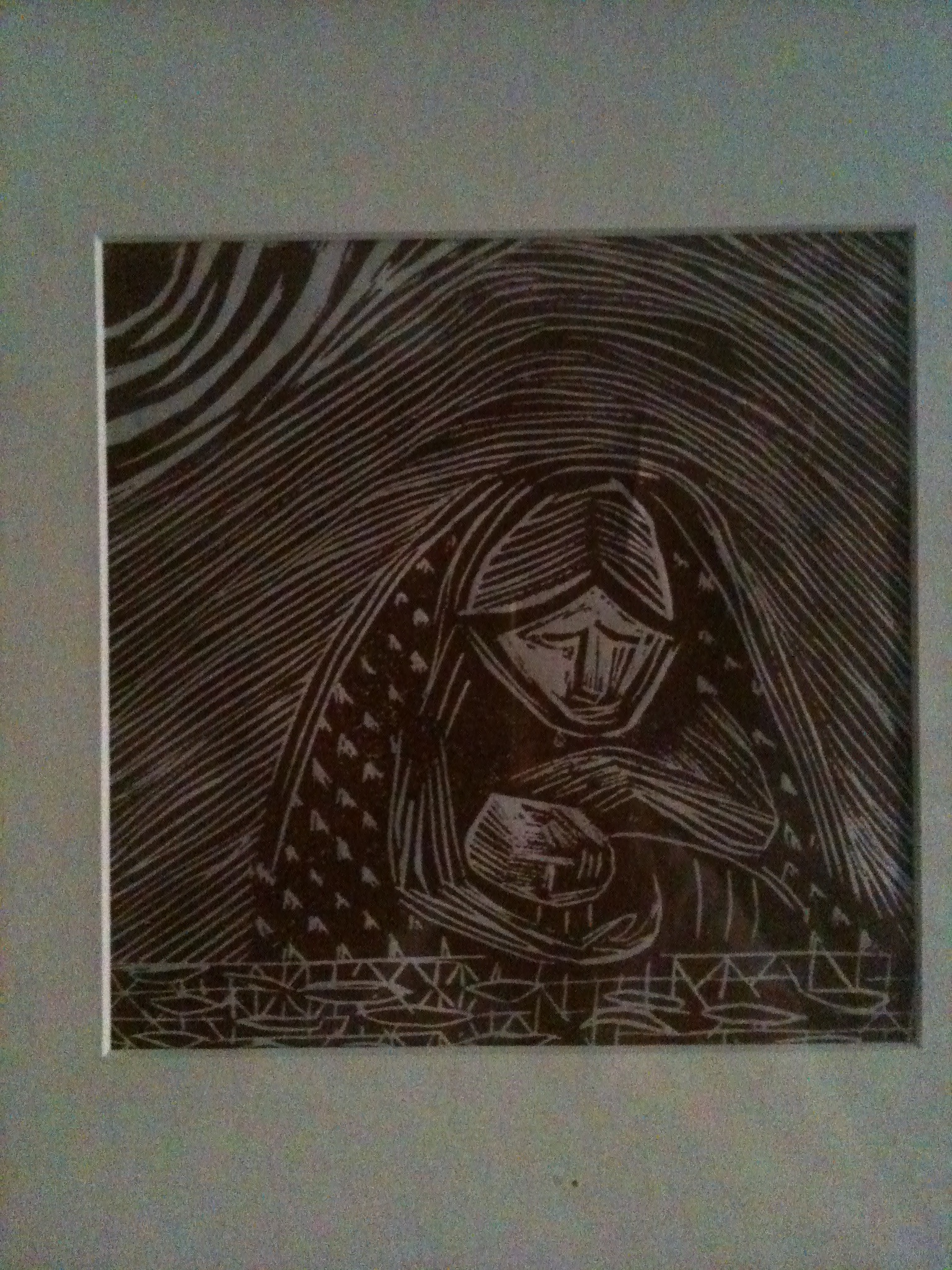
This linocut print of Offering  almost did not make it to my first solo exhibit because it looks more like a school exercise. But it is the very first piece of art I have rendered, and it is the story of Hagar.  I was asked if it was Mary, cradling Jesus as in the Pieta.

  I agreed that it could be interpreted in the same way, as Hagar is that story of a mother cradling her child.   These are limited edition prints.

Jacques Lipchitz’s  “Mother and Child” was loaned by the AGO for viewing at the second floor landing at the Four Seasons Centre from fall 2008 to summer 2010.

Posted in Uncategorized | 1 Comment

Sarah thy wife shall have a son Genesis 18:10


Posted in Uncategorized | 1 Comment

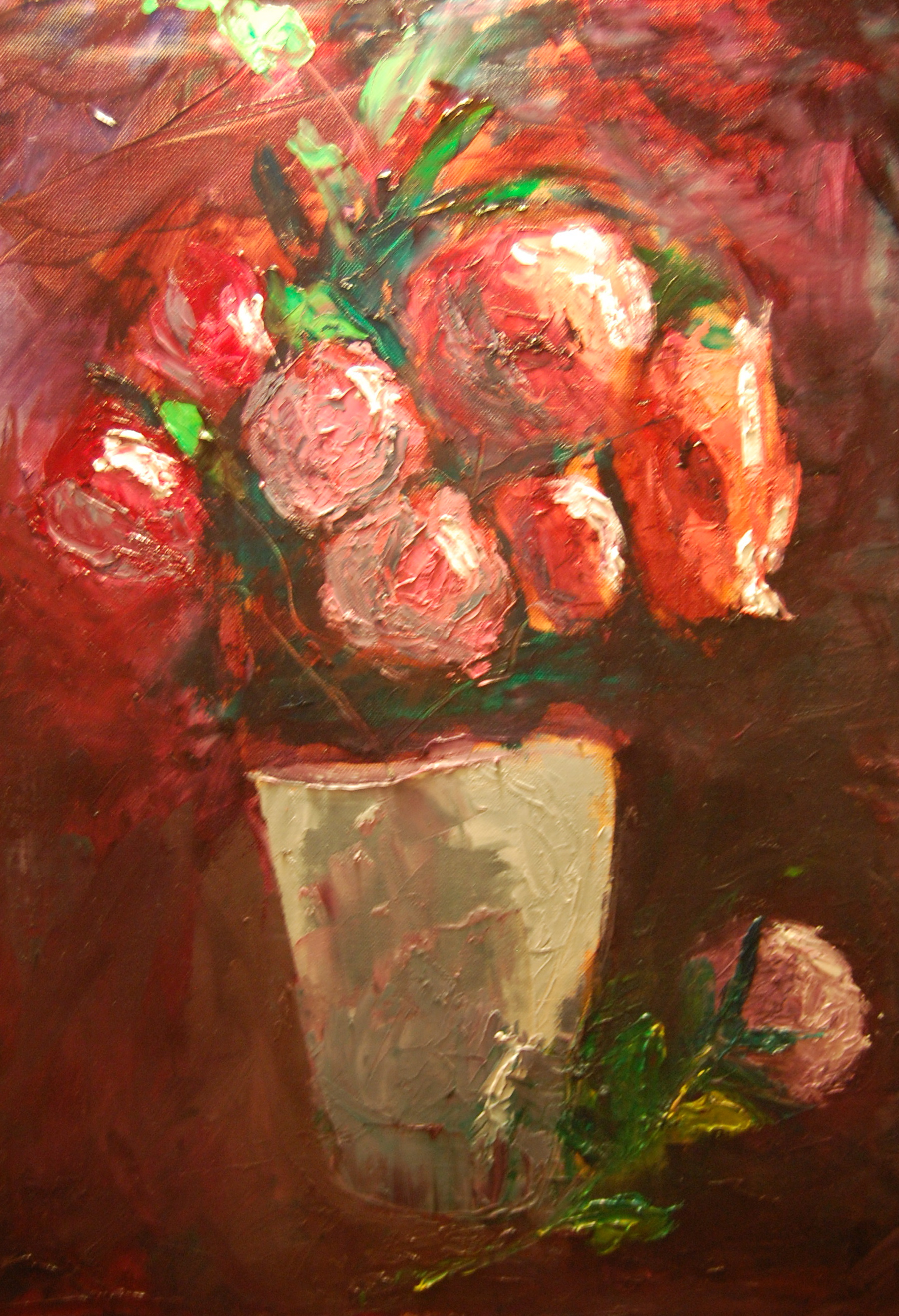
The Lone Rose


Posted in Uncategorized | 1 Comment

Art Talk


from a talk given on 5 February 2011

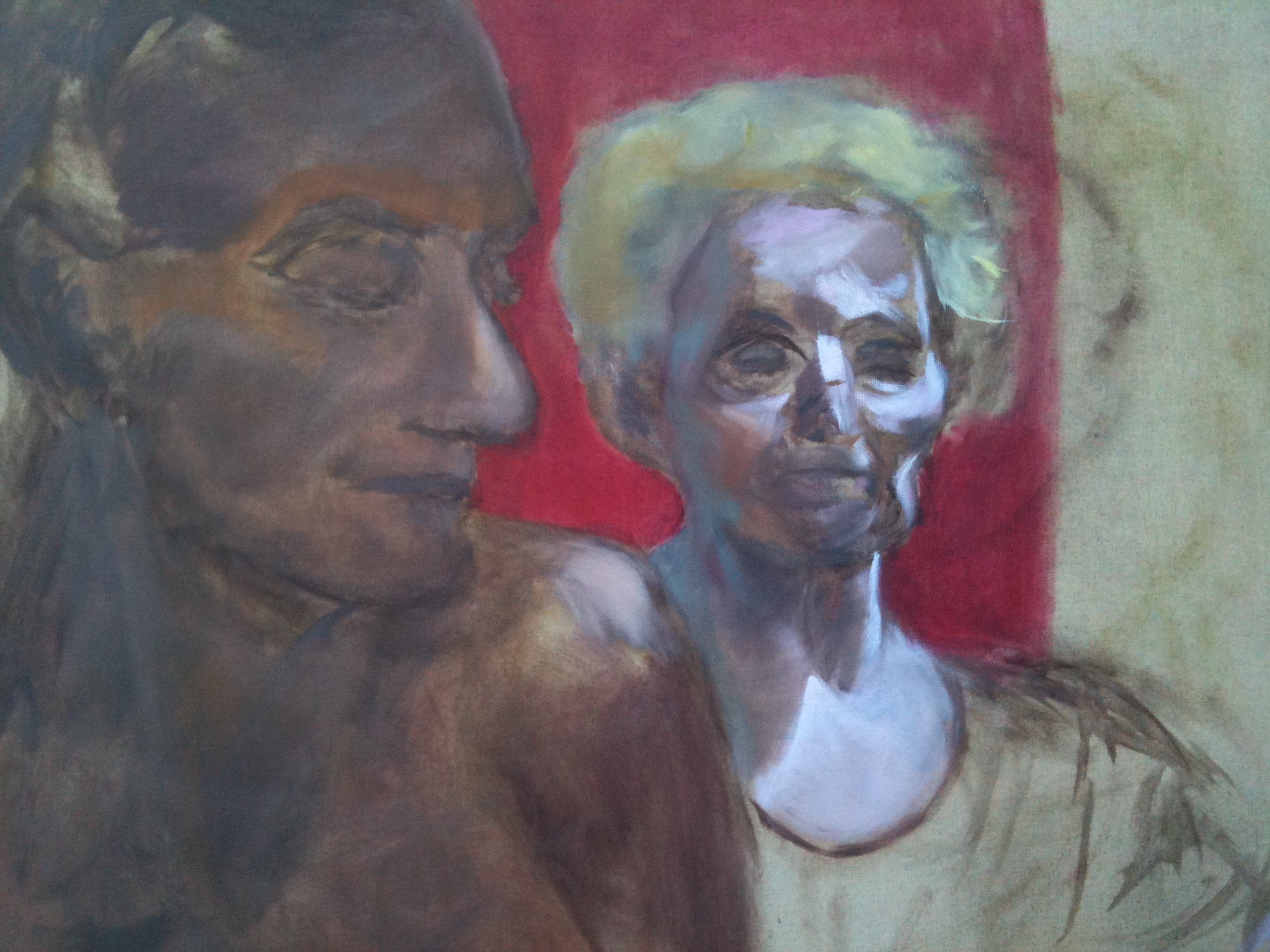
Art, as in painting, is another language.  And language, in a sense, is “transferring,” or translation. I recall my dad’s response to a woman’s impatience at his hesitation when talking about one of his paintings, “I would not have painted it if I could just as easily have spoken about it.”  It is this language that I am beginning to use, and my attempt to provide a material trace of narratives that have been interpreted, heard and transferred from many generations, that painting becomes storytelling.

What is language but just another interpretation, an act of transferring, “From my lips to your ears”?

It could very well be, “from my stomach to your breast,” when a baby indicates hunger to his mother.

We have many ways of communicating and visual imagery has its way of relaying a message just when the early cave dwellers drew pictures of buffalo on the cave walls, stating when the season of hunting is to be expected. “From my hands to your eyes,” to your mind… and so on.

All of us have the ability to create visual imagery.  In the stages of reading, teachers are well aware of the “Grade 4 or 5 cliff.”  Alarm bells ring if a child is unable to read at that age.

I have also observed that it is at that age when most of us, especially those who use this alphabet, stop drawing. At this stage, we usually have started acquiring an abstract sense of our world, identifying symbols as letters, attaching sounds to letters, and as the letters are compounded, we attach meaning to words. But there are times, when words lose their meaning.  This is usually illustrated in the way we use ritual words, or words of courtesy, such as, “please,” “thank you,” “good morning,” or “have a nice day.”

Our society attaches a lot of importance to those who practice the use of these words and we remark, “What a courteous young man! What a nice young lady!”

The age of texting added another complexity with the way we use words, but also an understanding of how well we have abstracted our thinking, where letters can be skipped and a meaning is derived… or perceived differently.

In the 1930s, a Southern politician successfully defeated a worthy opponent by spreading gossip that his opponent’s sister was a thespian and that his opponent practiced pre-marital inter-digitation.

In a way, this is the way we also hear stories.  When we were young, listening to a story being read or told to us, especially when the stories have become dear to us and a word goes out of place, we will say, “No.  That’s not how it goes.” But we don’t mind skipping over the difficult parts.  We make shortcuts, just like Disney would present the gory tales of Grimm into sweet, beautiful “G” rated movies and everyone lives happily ever after. Just as long as we say our “thank you” and “please,” we’ll be okay.

In a way, that is how most Christians read the Bible that is supposed to be the source of stories about faith.  We go immediately to the good parts, and gloss over the difficult parts and we read into it from a perspective of where we are.

A literal, factual approach to the Bible leads to a selective, absolute interpretation so while there are Christians who have no problem wearing clothes made from mix-blend fabric, these same Christians will tell you that homosexuality is a sin while the book of Leviticus speaks strongly against both practices.

Our own interpretations of The Bible are limited by our own perspective and beliefs. These interpretations have led some of us to overly defending and protecting its texts.  I believe that Scripture, just as in any other stories, must be also be read in the other’s eyes, “unprotected,” so to speak, [and Jennifer Knust already beat me to the term “Unprotected Texts.”] I hope that my visual renderings of these stories would amount to a material trace of the narratives, not that the images are masterfully represented, but are “brought to light” from a different perspective, an emerging perspective, as one who only started doing this about five years ago.

Posted in Uncategorized | Leave a comment

Transitions – 1st print posted


Light Break
Is not this the fast that I choose: to loose the bonds of injustice,
To undo the thongs of the yoke,
To let the oppressed go free, and to break every yoke?
Is it not to share your bread with the hungry
And bring the homeless poor into your house;
When you see the naked to cover them and not to hide yourself from your own kin?
Then your light shall break forth like the dawn
And your healing shall spring up quickly. [Isaiah 58:1-9a]
This is a silk screen of a photograph I took at the distillery before it was revitalized in the way we see today. This is a limited edition print.

Posted in Uncategorized | Leave a comment